Showing posts with label social theory. Show all posts

Friday, June 29, 2012

LASA

Alberto Moreiras has written a very nice article on the recent LASA Congress. It mainly comprises a series of reflections on the function played by the Congress itself and the trajectory of Latin American cultural studies over the past decade (a true "Latinamericanism since 9/11"). It then ends with some reflections on the discussions in San Francisco, via a rather promising account of posthegemony:
La posthegemonía es una modalidad de práctica teórica en la que caben innumerables tipos de análisis y tomas de postura, pues no es ni normativa ni prescriptiva: es sólo, y por lo pronto, el lugar de un posible encuentro capaz de generar pensamiento nuevo.

[. . .]

El término incluye de antemano su posibilidad crítica y resulta tan apropiado para pensar problemáticas estatales, es decir, en el registro del estado mismo y de la política de estado, como intra- o extraestatales (microfísicas comunitarias, regionales, ciudadanas o rurales, o bien macrofísicas de la globalización y su impacto), de marea rosada o neoliberales, populistas o no. Y en la medida no menor es que su productividad crítica está lejos de reducirse al pensamiento de lo político: constituiría también una herramienta fundamental para pensar la cultura, y con ella todas las modalidades de presentación de lo visible (estéticas, poéticas) al margen de postulados meramente identitarios. Tiene la capacidad de intervenir en cuanto crítica del conocimiento porque es antes que nada crítica de la ideología, y tiene la capacidad de proponer rearticulaciones políticas e intelectuales de todo tipo.

Alberto Moreiras, "¿Puedo madrugarme a un narco? Posiciones críticas en la Asociación de Estudios Latinoamericanos". FronteraD (June 27, 2012).

Saturday, January 08, 2011

negativity

Jason read has written a very interesting commentary on Benjamin Noys's book The Persistence of the Negative. It makes me all the more eager to read it--if only it weren't so damn expensive--even though (or perhaps especially because) my tendency, like Read's, is towards what we might call the philosophy of affirmation.

But in Read's words, Noys "is not interested in positing an ontology of negativity against the ontologies of affirmation. Negativity is a practice, not a principle, a destruction of existing positivities." And here I sense I agree with Noys. I'm likewise far from convinced by (say) Negri's unremitting championing of the multitude. As I point out in Posthegemony, we still need to be able to distinguish between good multitudes and bad, and to be able to discern when the multitude turns bad.

Or to put this another way: a philosophy of affirmation does not for all that have to be unrelentingly affirmative. Not everything is to be affirmed.

I agree also that the problem with Latour (and, I would add, Delanda) is that they present something of a mirror image of Negrian affirmation, in which it is rather contemporary capitalist relations (instead of the coming Communist utopia) which is relentlessly affirmed. Where Negri claims that "What ought to be, is," Latour and Delanda simply affirm that "What is, is what ought to be." Either way, critique is discarded.

And I am happy to agree in principle with the notion of negativity as "an insistence on localizing thought and practices, resisting both an ontology of affirmation and an ontology of finitude." Again, in large part, this is what I aim to show with the Latin American case studies in Posthegemony.

Tuesday, October 13, 2009

ignorant

Jacques Rancière's The Ignorant Schoolmaster may be egalitarian, but it is far from anti-authoritarian. Indeed, what's curious is the way in which the book implicitly argues for the superiority of traditional forms of authority, against the illegitimacy of modern expertise.

Rancière's book elaborates on the theory of intellectual emancipation propounded by the Frenchman Joseph Jacotot in the early nineteenth-century. Exiled from France after the conservative restoration, Jacotot found himself in Belgium where he was charged with teaching French to native Flemish-speakers. Knowing no Flemish himself, Jacotot was forced to rely on his students' abilities to glean the basics of French grammar from the bilingual edition of a French novel. This they did, with remarkable results. Thus Jacotot propounded a novel pedagogic theory whose basic principle was that "one can teach what one doesn't know" (15).

On this foundation, the observation that teaching is not a matter of communicating expertise from master to pupil, Jacotot develops an entire philosophy, which Rancière in turn seems to affirm. (It is hard to disentangle Rancière's voice from that of Jacotot.) The practice of explication, instruction, and interpretation is denounced. The true pedagogue enables the student to discover his or her own intelligence, rather than to be illuminated by the professor's. Or rather, it is suggested that all teaching is a matter of harnessing and guiding the student's will to learn; "explication is the myth of pedagogy," whose function is not to communicate knowledge but to produce "a world divided into knowing minds and ignorant ones, ripe minds and immature ones, the capable and the incapable, the intelligent and the stupid" (6). For in fact, all intelligences are equal, or of equal capacity--this at least is the hypothesis or opinion that an emancipatory pedagogy sets out to verify.

Hence the radical egalitarianism: all intelligences are of the same kind and "any human work of art is the practice of the same intellectual potential" (36); it is just that sometimes that potential is developed, and sometimes it is constrained. Moreover, one of the foremost forces to constrain the development of natural intelligence is the very educational system that claims that this is its object. The school doesn't educate; it stultifies.

But hence therefore the strange reversion to traditional authority: the business of education has to be taken from the educational system and returned to the family. Intellectual emancipation cannot be systematized; "universal teaching belongs to families, and the best that an enlightened ruler can do for its propagation is to use his authority to protect the free circulation of its service" (103).

For it is not that Jacotot (or, implicitly, Rancière) would be done with authority: his students "had learned without a master explicator, but not for all that, without a master" (12). If anything, the new master is more demanding than the old one in forever insisting that the student pay attention and direct his or her will to achieving their own potential: "Is this insignificant? Think about everything the demand implies for the student in the way of an endless task" (31).

So it is perhaps unsurprising, if unfortunate, that the family is chosen as the sole legitimate sphere for universal education on the basis that (and here Rancière is directly quoting Jacotot) it "was the sanctuary where the father was the supreme arbiter" (105). The "natural method of the human mind" (105) appeals to the supposed naturalness of patriarchal authority for its implementation.

All this is strangely anti-social in every sense of the term, and it's not clear how much it jives with Rancière's later concern with precisely the institution of the social (however precarious and necessarily incomplete). But it ain't necessarily so. For surely this strong division between natural families and un-natural social institutions itself merely replicates the false dichotomy between pedagogy and instruction.

After all, explicators and instructors are in fact pedagogues, though they are (ironically) ignorant of the fact: "learning also takes place at the stultifiers' school; a professor is a thing, less easily handled than a book, undoubtedly, but he can be learned" (102). As such, rather than legitimating the authority of the patriarchal family, surely another route towards emancipatory pedagogy would be the further objectification of the professoriat?

Wednesday, October 31, 2007

heterotopia

The Wednesday quotation, part VIII: Foucault on pirate heterotopias.
Brothels and colonies are two extreme types of heterotopia, and if we think, after all, that the boat is a floating piece of space, a place without a place, that exists by itself, that is closed in on itself and at the same time is given over to the infinity of the sea and that, from port to port, from tack to tack, from brothel to brothel, it goes as far as the colonies in search of the most precious treasures they conceal in their gardens, you will understand why the boat has not only been for our civilization, from the sixteenth century to the present, the great instrument of economic development (I have not been speaking of that today), but has been simultaneously the greatest reserve of the imagination. The ship is the heterotopia par excellence. In civilizations without boats, dreams dry up, espionage takes the place of adventure, and the police take the place of pirates. (Michel Foucault, "Of Other Spaces." Lecture given in March 1967, printed in Diacritics 16 [1986]: 22-27 [27])
This is a guest post because the quotation was suggested by my brother, Tim.

Saturday, June 23, 2007

persistence

The social order is merely the order of bodies: the habituation to custom and law that law and custom produce by their very existence and persistence is largely sufficient, without any deliberate intervention, to impose a recognition of the law based on misrecognition of the arbitrariness which underlies it. (Bourdieu, Pascalian Meditations 168)

Para conocer a Pinochet, basta con leer sus declaraciones [. . .] sus palabras lo dicen todo. (Nelson Caucoto, in Luis Alejandro Salinas, The London Clinic 12)

“Tiredness and waiting,” observes Deleuze, “even despair are the attitudes of the body” (Cinema 2 189). We are some distance here from nomadic lines of flight, even if Deleuze’s point is to underscore the Spinozan maxim that “we do not even know what a body can do” (189). The body opens up a world of immanent resistance and Exodus: an “imperceptible passage of attitudes and postures to ‘gest,’” a Brechtian shock that is “necessarily social and political” as well as “bio-vital, metaphysical, and aesthetic” (192, 194). Yet, “obstinate and stubborn” (189), weary and worn down, often enough the body is simply a creature of habit. At its most reduced, most contracted, affect becomes habit. For instance, the tick inhabits “a world with only three affects, in the midst of all that goes on in the immense forest” (Deleuze, Spinoza 124-125). It seeks light, to climb a branch; smell, to detect and drop down on an animal passing below; and warmth, to burrow into that animal’s skin. These three affects are an index of the tick’s power, what its body can do; and they enable the tick’s becoming, its leap and clandestine submergence within a host animal’s hide. But these same affects also structure a profound passivity, a “tiredness and waiting” that reaches its apogee in the famous Rostock tick that, as Agamben reports, zoologist Jakob von Uexküll “kept alive for eighteen years without nourishment” (The Open 47). The tick figures the persistence of habit, a captivation or “remaining-inactive” in which everything continues the same (68).

For Agamben, we are closer to the tick than ever: “for a humanity that has become animal again, there is nothing left but the depoliticization of human societies” (76). We are hardly even bored any more, for boredom is at least the “awakening of the living being to its own captivation” (70), a realization of our own habituation. On television, we are obsessed with people like us who, as with the Rostock tick, are denied almost all external stimulus (reality TV’s Big Brother). On the Internet, millions surf listlessly, perhaps with half an eye on webcams of coffee warming (http://www.cl.cam.ac.uk/coffee/coffee.html) or paint drying (http://www.watching-paint-dry.com/). Ours is but a bare life, all the more so for the routines that fill it, captivating us as much as the tick is captivated by the meager affects that constitute its plane of immanence. Contemporary culture is pervaded with the sense that most of us are condemned to cubicles and McJobs, a world of blank indifference enlivened only by petty rivalries with co-workers or grievances towards employers. After its initial shock, even terror becomes routine: we adapt to the search procedures of airport security just as British shoppers in the 1970s adjusted to the inconveniences of IRA bomb threats. Few of us really believe either in the threat or, still less, in the measures taken to deter it (which is in part why terror maintains its power to shock); but we go along with the rigmarole, altering our habits accordingly. Our bodies become accustomed to waiting in line, to passing through metal detectors, to iris scans and security patdowns.

Few of us believe: habit persists even when ideology fades. Our contemporary condition is the cynicism outlined by Peter Sloterdijk, "a universal, diffuse cynicism," which is "that state of consciousness that follows after naive ideologies and their enlightenment" (Critique of Cynical Reason 3). The paradigmatic cynic is "an average social character in the upper echelons of the elevated superstructure" (4) who is aware that he or she is exploited in work and alienated in the face of the culture industry, but who continues on none the less, in the spirit of "a detached negativity [. . .] that scarcely allows itself any hope, at most a little irony and pity" (6). Now a host of books, from Timothy Bewes’s Cynicism and Postmodernity to Wilber Caldwell’s Cynicism and the Evolution of the American Dream, indicate that, in William Chaloupka’s words, “over and over, cynicism pops up as a description of our society’s problems” (Everybody Knows 5). Moreover, today this cynicism is more diffuse, no longer restricted to Sloterdijk’s “upper echelons.” In what is often regarded as a sign of widespread depoliticization, we are all cynical now, thanks to a “mass cultural retreat from politics itself” (Bewes 3).

Read more... (large .pdf file)

Sunday, April 29, 2007

conatus

Approaching the end of the current chapter, I'm coming to see conatus as a key concept. This is both blindingly obvious and a Eureka moment (and a Eureka moment is always the sudden realization of the obvious): after all, conatus is almost the only term that Deleuze, Bourdieu, and Negri have in common.

Bourdieu adopts the concept quite late on, and never fully develops it. I think, moreover, that it reveals a striking ambiguity in his work. Here is a lengthy passage in which he employs the term in a response to his critics; and note that he is apparently defending himself from the charge of determinism. It's also, incidentally, part of a section on "historicist ontology":
The relation between habitus and the field through and for which it is created is an unmediated, infraconscious, practical relation of illusio, of investment, of interest in the game, which implies a sense of the game and a sense (which the twofold meaning of orientation, direction, and signification) of the history of the game; in short, a practical anticipation or inclination not to be mistaken for a conscious project or a calculated scheme. This investment, realized only in the relation between habitus and field, is the specific libido, the socially constituted and fashioned principle of every action. Both habitus and field (and also the specific form of capital produced and reproduced in this field) are the site of a sort of conatus, of a tendency to perpetuate themselves in their being, to reproduce themselves in that which constitutes their existence and their identity (for instance, in the case of the bourgeois habitus, the system of diferences and distances constitutive of distinction). This I hold against a finalist, utilitarian vision of action which is sometimes attributed to me. It is not true to say that everything that people do or say is aimed at maximizing their social profit; but one may say that they do it to perpetuate or to augment their social being. ("Conclusion" 274; my emphasis)
The first thing to say is that if this is a defence against determinism, then my goodness! For it's a very strong statement of the principle of reproduction, of what elsewhere Bourdieu terms the "specific inertia" of both habitus and field.

But here's the ambiguity: is it not a very different thing to attribute conatus to a habitus rather than to a field?

For in so far as a group or subject struggles "to perpetuate or to augment [its] social being," is is constantly struggling against the countervailing tendency of the field to seek to perpetuate its social being. Precisely because there's always a slippage between habitus and field, there's therefore also a constant struggle between the two, even as habitus is also the means by which a field reproduces itself. (And also vice versa?)

Bourdieu sometimes, as here, recognizes the possibility of a group conatus, a striving distinct from the social field. But too often he considers only the field's self-reproduction, as for instance when he describes habitus as "one of the mediations through which the social order fulfils its tendency to persevere in its being, in a word, its conatus" (Pascalian Meditations 152).

But again, especially in so far as a social subject strives to augment its social being, then that subject is always in conflict with the field in which it expresses that striving.

To put this at its most schematic, borrowing from Marx's formula for the commodity (which may or may not be apposite): one could either consider the interplay between habitus and field from the perspective of the field, and the (differential, historical) reproduction of the social order, viz. Field-Habitus-Field, or F-H-F'. Alternatively, however, from the perspective of the group (and part of the problem is that Bourdieu has no real theory of the group, or rather no immanent theory), the formula would be H-F-H'.

Here, then, is May 1968 explained in almost precisely these terms, and in contrast to any ideological analysis. Against suggestions that the prime cause of the événements was "the diffusion of learned ideologies--such as that of Marcuse," Bourdieu argues that
This semblance of ideological diffusion results in fact from the multiplicity of simultaneous but independent, albeit objectively orchestrated, inventions, realized at different points of the social space, but in similar conditions, by agents endowed with similar systems of dispositions and, so to speak, the same social conatus (by which we mean that combination of dispositions and interests associated with a particular class of social position which inclines agents to strive to reproduce at a constant or an increasing rate the properties constituting their social identity, without even needing to do this deliberately or consciously). (Homo Academicus 176; emphasis in original)
Now, again for all Bourdieu's stress on "inventions" there's a clear reductionism implied here. But it ain't necessarily so. Not if we regard, as Spinoza does, conatus as itself the essence of a body, so that an increase in power is also a change in social identity or state, because it is a change in the power to affect or be affected.

Finally, it's worth pointing out that this struggle, this conflict between habitus and field and their two conatus (conati?) takes place via the encounter, good or bad, positive or negative. In the slippage between habitus and field, either sad or joyful passions can be engendered, leading to a transformation either of habitus or indeed of the field itself. Bourdieu once more:
One can also say, following the same logic, that habitus helps to determine what transforms it. If it is accepted that the principle of the transformation of habitus lies in the gap, experienced as a positive or negative surprise, between expectations and experience, one must suppose that the extent of this gap and the significance attributed to it depend on habitus: one person's disappointment may be another's unexpected satisfaction, with the corresponding effects of reinforcement or inhibition. (Pascalian Meditations 149)
Yes, the functionalist tenor persists. But the "surprise" of the encounter has surely also to be the location of a certain unpredictability--a surprise, if you like, also for the analyst. And equally the field (as well as the habitus) must also be affected variably, by either reinforcement or inhibition.

Either way, however, the segue to the multitude becomes clear.

And I wonder if we could posit a disparity similar to that posited by Negri for the multitude... I.e. whereas the field (and social reproduction) is dependent on habitus, is habitus really dependent on the field in the same way? I'd wager that it isn't.

Tuesday, April 24, 2007

historicity

More...

Belief is a matter of the body: "To speak of 'ideologies' is to locate in the realm of representations [. . .] what in fact belongs to the order of belief, that is, to the level of the most profound corporeal dispositions" (Practical Reason 55). It is also therefore immediate. Bourdieu adapts and radicalizes Pascalianism. If for Pascal, belief arises from corporeal dispositions, for Bourdieu it is located in those dispositions themselves, and needs never rise to consciousness. Though praising Pascal's challenge to "all those who insist on seeing belief in terms of representations" (The Logic of Practice 49), Bourdieu argues that Pascal maintains a pre-eminence of consciousness over practice, "as if will and consciousness were the basis of the disposition which 'with no violence, art or argument makes us believe'" (49). For Bourdieu, however, dispositions are always primary: "what is essential goes without saying because it comes without saying" (Outline 157; emphasis in original). There is no prior decision, and so no wager. Institutions work directly on the body; social order produces no rationale so long as it needs none, and "the principles embodied in this way are placed beyond the grasp of consciousness" (94). Everything begins and ends at the level of the corporeal, as we are habituated to subjection. We are steeped in doxa, "the relationship of immediate adherence that is established in practice between a habitus and the field to which it is attuned, the pre-verbal taking-for-granted that flows from practical sense" (The Logic of Practice 68). Despite its immediacy, however, there is always some slippage between habitus and social order. Something always escapes. For as a deposit of the power relations that structure a given social field, habitus is always a residue, an embodied memory of a previous state of that field. And because fields are always in flux, in that their contours are determined only in the course of a permanent struggle between social agents and their continual position-takings, habitus and field are never fully synchronized. Hence the historicity of habitus, or rather what Bourdieu terms its "double historicity" in that it is both the product of history and the force that, by generating practice, produces history (Invitation 139; see also Outline 82). More fundamentally still, habitus generates time itself, for "time is what practical activity produces in the very act whereby it produces itself. [. . .] Time is engendered in the actualization of the act" (Invitation 138). History and time, in short, are also fully immanent: "the theory of practice condensed in the notions of field and habitus allows us to do away with the metaphysical representation of time and history as realities in themselves, external and anterior to practice" (138).

The historicity of habitus secures social reproduction, but also and at the same time allows for the possibility of resistance. It is because the practices it generates express dispositions structured by a previous state of the field, that habitus provides the continuity that ensures that historical structures are reproduced in the present. But the encounter between dispositions shaped by history and the field in its current state, and the inevitable slippage between the two, makes for unpredictable effects and so the possibility of a new history. Habitus ensures resonance, but also leads to dissonance. Hence the "hysteresis effect necessarily implied in the logic of habitus," which means that "practices are always liable to incur negative sanctions when the environment with which they are actually confronted is too distant from that to which they are objectively fitted" (Outline 78). Hysteresis can account for missed opportunities, for clumsy or unsuccessful practices by which an individual or group confirms, despite themselves, their social decline. Equally it can provide an embodied memory that serves as a resource or resistance, just as Paul Gilroy argues that the "structures of feeling which underpin black expressive cultures" derive from embodied memory both of "the once forbidden drum" and of "a terror which has moved beyond the grasp of ideal, grammatical speech" (The Black Atlantic 77, 76, 71). In either case, the gap that arises in the slippage between embodied structures and actual practices opens up a time for strategy. It is the strategic aspect of practice that means we can speak of a social game: though the playing field is never level, structured as it is by symbolic domination and unequal distributions of capital, still the result of each move is always partly in doubt. Time enables strategy, which in turn depends upon timing. As Bourdieu observes in his analysis of gift exchange, what counts is not some transcendent structure or invariable rules, but "the tempo of action" and "the interval between actions," such that a successful outcome is guaranteed only by the skilful management of time, by acting neither too precipitately nor too late (The Logic of Practice 106).

Saturday, April 21, 2007

field

The key to the difference between Bourdieu and Deleuze, and so to the specificity of the concept of habitus, consists in Bourdieu’s introduction of the related concepts of “field” and “symbolic capital.” For Bourdieu, habitus is always embedded in a prior social field, which itself is structured by symbolic power. In some ways Bourdieu takes more seriously than Deleuze, then, the notion encapsulated in Deleuze and Guattari’s affirmation that “politics precedes being” (A Thousand Plateaus 203). For if habitus is a set of “structured structures predisposed to function as structuring structures” (The Logic of Practice 53), it is not only generative but also generated. It is the product of a given state of power relations: the social field as a whole, and also distinct subfields (such as the artistic field, the journalistic field, the academic field). Hence, in Loïc Wacquant’s words, the relation between habitus, field, and capital is that “a field consists of a set of objective, historical relations between positions anchored in certain forms of power (or capital), while habitus consists of a set of historical relations ‘deposited’ within individual bodies” (Bourdieu and Wacquant, An Invitation to Reflexive Sociology 16). Hence the dispositions of habitus are also depositions, both in the sense that they constitute a record of the state of the field that formed them and (to use now more Deleuzian terminology) that they are the sediments or deposits that form within a particular landscape of power. They are “conditionings associated with a particular class of conditions of existence” (The Logic of Practice 53). And what they therefore generate or structure in turn tends therefore to reproduce the structures that constituted them, in that they generate practices that seem to call those structures into being, that take them for granted without the need of words or discourse.

Each field is structured by a competition for domination and capital. “The structure of the field,” Bourdieu argues, “is determined by the structure of the distribution of the distinct forms of capital that are active in it” (An Introduction to Reflexive Sociology 108). For there are different forms of capital, each of which has a different weight depending upon the field in question. Broadly, for instance, the field of culture is structured in terms of its differential distribution of cultural capital, while it is financial capital that counts in the market for economic goods. Yet Bourdieu downplays the direct influence of financial capital, and is interested above all in the distinct forms of symbolic capital that are subject to struggle in different subfields, and the ways in which the definition of capital (or what is to be accorded value) is at stake in these struggles, as well as the mechanisms by which one form of capital is converted into another. In the end, the most effective power is symbolic: “symbolic” here does not imply either representation or a power that is “merely” symbolic, but refers a mode of domination that achieves legitimacy in that its arbitrariness is misrecognized, so much so that it goes without saying. Bourdieu and Passeron present this as the fundamental axiom grounding their analysis of social reproduction: “every power which manages to impose meanings and to impose them as legitimate by concealing the power relations which are the basis of its force, adds its own specifically symbolic force to those power relations” (Reproduction 4; emphasis in original). What is reproduced through habitus, habitually, is our corporeal assent to the legitimacy of these power relations, and to the unequal distribution of capital that they secure.

Habitus is reflex and relay, product and producer, assuring social continuity by literally incarnating the principles of social order. In Bourdieu’s words, “it ensures the active presence of past experiences, which, deposited in each organism in the form of schemes and perception, thought and action, tend to guarantee the ‘correctness’ of practices and their constancy over time” (The Logic of Practice 54). It ensures that social agents are attuned to their circumstances. It fosters the self-confidence of the “inheritor” who, rich in cultural capital, exhibits a confidence and flair that is rewarded with further social and cultural capital; and it also ensures that those dispossessed of cultural capital assent to their dispossession by rejecting what is culturally consecrated (be it higher education or high art) with the sentiment that it is not for them. Privilege is naturalized as though it were simply a “gift”; and subordination is taken for granted as though social difference were a question of talent or taste. The dispossessed are often the first to admit that they have only themselves to blame. And all this is legitimated and arbitrated by institutions and officials who have no need to be aware of what they are doing, who can be committed or even (increasingly) entirely cynical about the ideals they are upholding. For ideals are not at stake. Academic diplomas, for instance, attest to “gifts” and “merits,” and can do so objectively with no hint of bias, because the real work has been done in the conversion and so dissimulation of privilege as attitude. The source of these dispositions is concealed, all the more effectively in that the habits they generate are second nature. Hence, Bourdieu and Passeron argue, “the supreme privilege” of the privileged is “not seeing themselves as privileged,” which in turn “manages the more easily to convince the disinherited that they owe their scholastic and social destiny to their lack of gifts and merits, because in matters of culture absolute dispossession excludes awareness of being dispossessed” (Reproduction 210). There is no conspiracy because there is no hidden knowledge: the game’s winners as much as the game’s losers, as well as its arbitrators, can all act in perfectly good faith. The judgments that lead to social promotion or exclusion, such as the feeling that “he’s a good chap” or “she’s not one of us,” can be justified by transcendent principles whose legitimacy is assured by the fact that they resonate with immanent habits.

Wednesday, April 18, 2007

habitus

Something I'm working on, and I thought I'd put it up to see what the various Bourdieusians and Deleuzians make of it...


Bourdieu’s concept of “habitus” is, in the first place, central to his intervention into the ongoing debate about structure and agency, “one of the key faultlines that runs through social theory” (Korczynski, Hodson, and Edwards, “Introduction” 12). On the one hand, there are theorists who stress the ways in which social structures constrain and determine individual or social agency. Marxism and psychoanalysis, for instance, in different ways tend to emphasize the ways in which agency is constrained by structures that are, respectively, material and psychic. On the other hand, other theorists stress the fact that agents can resist or overcome these structural determinants. The tendency of cultural studies, for example, is to point to the slippages by which (say) consumers determine their own responses and eke out a measure of agency even within contemporary capitalism. Or as Anthony Giddens (whose theory of structuration is an alternative bid to resolve the debate) puts it, those for whom “structure (in the divergent senses attributed to that concept) has primacy over action, and the constraining qualities of structure are strongly accentuated” are arrayed against those for whom “action and meaning are accorded primacy in the explication of human conduct; structural concepts are not notably prominent, and there is not much talk of constraint” (The Constitution of Society 2). Giddens goes on to characterize this difference as an “imperialism of the social object” facing “an imperialism of the object” (2). In short, these are two competing claims to transcendence; what is at stake, Giddens argues, is as much ontological as it is epistemological, as much about our models of what society is as about conflicting perspectives regarding the same model (2).

Bourdieu’s intervention is therefore also ontological, substituting immanence for the dueling imperial transcendences of structure and agency. He refuses both “mechanism” (an emphasis on structure) and “finalism” (a stress on agency), arguing that the debate between the two is “a false dilemma” (Outline of a Theory of Practice 72). If “it is necessary to abandon all theories which explicitly or implicitly treat practice as a mechanical reaction” shaped by rules or structures alone, equally “rejection of mechanistic theories in no way implies that [. . .] we should reduce the objective intentions and constituted significations of actions and works to the conscious and deliberate intentions of their authors” (73). Mechanism and finalism, structure and agency, are each as reductionist as the other, seeking causes always elsewhere, in some other dimension, either the “transcendent, permanent existence” of objective social constraints and regulations or the “transcendence of the ego” equipped to make its own rules (27, 75). So Bourdieu turns to habit, or “habitus,” an embodied set of dispositions immanent to practice itself. Habitus is a system “of durable, transposable dispositions, structured structures predisposed to function as structuring structures, that is, as principles which generate and organize practices and representations” (The Logic of Practice 53). These dispositions are “objectively ‘regulated’ and ‘regular’ without in any way being the product of obedience to rules, objectively adapted to their goals without presupposing a conscious aiming at ends” (Outline 72). Habit, our everyday activity, is therefore the product of a “scheme (or principle) immanent in practice, which [. . .] exists in a practical state in agents’ practice and not in their consciousness, or rather, their discourse” (27; emphasis in original). Regulation and practice are immanent to each other, rather than mediated either by consciousness or by external structures. Habitus is an attitude of the body. It is the unspoken, unspeakable, feel for the social game that generates the positions and actions that agents adopt in given situations, in regular if not fully predictable ways. In short, because it is immanent, habitus is both embedded, and so structured; and it is also generative, an immediate rather than external motor of action.

There are many overlaps between Bourdieu’s habitus and Deleuze’s conception of the “virtual.” Both are immanent and productive, intensive and affective, corporeal and immediate. The relation between habitus and practice is not unlike that between the virtual and the actual: an unfolding or differentiation that takes place in the event of an encounter with other bodies. Habitus and the virtual alike describe an ontology that underlies but is of a different order from the realm of representation, discourse, and ideology. Habitus, Bourdieu tells us, is like the work of art in that it “always contains something ineffable, not by excess [. . .] but by default, something which communicates, so to speak, from body to body, i.e. on the hither side of words and concepts” (Outline 2; emphasis in original), while the virtual, Brian Massumi explains, is “the unsaid of the statement, the unthought of thought” (A User’s Guide 46; emphasis in original). Hence both theorists’ distaste for ideology: for Deleuze and Guattari, “there is no ideology and never has been” (A Thousand Plateaus 4); for Bourdieu, more measured, “I have little by little come to shun the use of the word ‘ideology’” (Pascalian Meditations 181). And yet, despite these manifold similarities, the tenor of Bourdieu’s work differs markedly from Deleuze’s. Where Deleuze emphasizes escape, and a flight towards the immanent virtuality of affect as an empowering realization of what the body can do, for Bourdieu the immanence of habitus is characterized above all by inertia. Bourdieu shows how habit enables social reproduction and works against radical social change, so much so that (as Bourdieu and Wacquant note) some even accuse him of “a politically sterile hyperfunctionalism” (An Invitation to Reflexive Sociology 52). Though his “functionalist tenor” (Lane, Bourdieu’s Politics 116) does not exhaust Bourdieu’s account of habit, the contrast with the voluntarist tenor of Deleuze’s theorization of affect is dramatic. Yet the difference is not, as Massumi claims, that habitus is an “ideological notion” whereas Deleuze’s account “emphasizes that [habit] belongs as much to the organic stratum, to the productive, physiological capacities of the flesh” (“Introduction” xxxvii). Bourdieu’s habitus is fully as corporeal as Deleuze’s affect. Rather, we might almost say that the structure and agency debate is replicated in the difference between Deleuze and Bourdieu, but now as a contest between two immanences.

Thursday, November 23, 2006

promotion

Via Left Turns? (and also my colleague Max Cameron), an interesting article on "democracy promotion," and specifically Canada's role supporting and providing an alibi for US "overt operations" in Latin America: "Canada's Contribution to 'Democracy Promotion'".

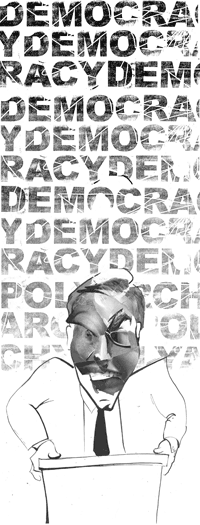
democracy cartoonWith a particular focus on FOCAL, the Canadian Foundation for the Americas, Anthony Fenton describes Canada's role as a National Endowment for Democracy "proxy" in "this new genre of political intervention into the affairs of the nations of the Global South."

The article is of special interest to me in part because (along with Max) the other day I met up with Carlo Dade, a former World Bank employee who is described here as "a FOCAL senior advisor" and "the main point person for FOCAL’s 'Canada and the Rebuilding of Haiti' program." Dade is quoted quite unabashedly arguing for Canada's proxy role in support of US policy objectives in Latin America:
The U.S. would welcome Canadian involvement and Canada’s taking the lead in Haiti. The administration in Washington has its hands more than full with Afghanistan, Iraq. . . This is a chance for Canada to step up and provide that sort of focused attention and leadership, and the administration would welcome this.
Dade was a nice enough guy to have a beer with, but it was indeed quickly apparent that his version of "democracy" was unashamedly tied to free markets and private sector interests.

Canada's role in these overt operations, to push a particular formula of social governance on Latin America, is legitimized by the linguistic slip that ties the country's self-image of itself as a "civil society" (in the sense of peaceable and polite) to the concept of civil society, or Hegel's "bürgerliche Gesellschaft" (bourgeois society), as a bulwark against authoritarian states and radical social movements alike.

Thursday, November 02, 2006

aberrations

Marguerite Feitlowitz's A Lexicon of Terror: Argentina and the Legacies of Torture examines the relation between language and state violence. In some ways it's a companion piece to Diana Taylor's Disappearing Acts, which analyzes a similar connection between performance and terror, also focussing on Argentina.

The New York Times has an online version of the book's first chapter, whose title is likewise "A Lexicon of Terror", and where we find her most sustained examination of the role of language under Argentina's military regime of 1976 to 1983.

War is PeaceSince Orwell at least, we've been familiar with the concept that authoritarianism impacts language, bending it out of shape and introducing a whole series of figures and double meanings that violate common sense: war is peace; freedom is slavery; ignorance is strength. Doublespeak. And in "Politics and the English Language", for instance, Orwell insists upon linguistic clarity as a remedy to political obfuscation: in so far as "the present political chaos is connected with the decay of language [. . .] one can probably bring about some improvement by starting at the verbal end. If you simplify your English, you are freed from the worst follies of orthodoxy."

But as Feitlowitz observes, while the Argentine junta made use of language's slipperiness precisely in the service of something like Orwellian doublespeak (e.g., in a distortion of human rights discourse, "We Argentines are human, we Argentines are right"), they were also quite self-conscious and wary about the sign's inherently arbitrary relation to its referent. In the words of Admiral Emilio Massera, with which Feitlowitz opens her chapter, "Unfaithful to their meanings, words perturb our powers of reason" (19).

So in that "the whole regime was intensely verbal," as Feitlowitz contends, with its "constant torrent of speeches, proclamations, and interviews" such that "Argentinians lived in an echo chamber" (20), not only did the junta remake language, it also opened up the possibility that its own language could be turned against it. Indeed, this was (as Taylor argues) something that the Mothers of the Plaza de Mayo realized: that they could take the regime's rhetoric about the centrality of the family and women's role as nurturers and guardians, and turn it against the practices that separated mother from child through kidnap and torture.

There are two possible positions: one insists on clarity and common sense against the obfuscations and euphemisms of overweening power; the other thrives on the fact that even the most powerful cannot fully control their language (or anybody else's).

The problem is that Feitlowitz never fully chooses either one of these possibilities. And as such, she constantly falls prey to the worst of all worlds. Consider her chapter's conclusion:
The repression lives on in [. . .] aberrations of the language, in the scars it left on the language. When a people's very words have been wounded, the society cannot fully recover until the language has been healed. [. . .] When, like skin, the language is bruised, punctured, or mutilated, that boundary [between inner self and the outside world] breaks down. [. . .]

We must pay attention to this dis-ease, we must document its signs. We must make an artifact of this Lexicon of Terror, so that it will no longer be a living language. (62)
Here is a denunciation of language's aberration expressed in the most aberrant of language. Is it not, after all, a form of "doublespeak" to use such a richly figural, metaphoric mode of expression as to refer to language's "scars," its bruises, punctures, and wounds? And while we're at it, why does this linguistic cure depend upon killing a "living language"?

How far, after all, are we from the Argentine junta's own metaphorical analogies, condemned by Feitlowitz, to the "cleanliness and health" that they propose to bring to an Argentina purged of political aberration (33)? If Massera is wrong to appropriate what Feitlowitz terms "Neo-Nazi 'germ theory'" when he declares that "we must cleanse the country of subversion" (33), is it not equally problematic to portray language itself as a body whose sickness is to be cured or as a life that is to be euthanized . . . especially when it is metaphorical aberration that is to be purged, linguistic excess to be eliminated?

In other words, Feitlowitz uses metaphor to argue for de-metaphorization.

We should either use metaphor or denounce it. And if it turns out that we cannot rid our language of figures, then perhaps there's a limit to the political blame we can pin on figuration per se. All the more so when we've borrowed our most powerful figures from those we claim to be condemning.

(Paul de Man's "Semiology and Rhetoric" [JSTOR access required] has something to say about this, too.)

Wednesday, September 20, 2006

modest

Princess Diana in AfricaI had the good fortune this week to read a wonderful book proposal about development work, and more specifically the "desire for development," particularly among white women in the North.

The focus is on Canadian aid workers in sub-Saharan Africa, and the ways in which their investment in their work (and even their resistance) enables their self-constitution as moral subjects. The manuscript includes the following marvellous quotation about the ways in which the assumption of global difference constructs and confirms a sense of moral purpose in Canada above all:
A Canadian today knows herself or himself as someone who comes from the nicest place on earth, as someone from a peacekeeping nation, and as a modest, self-deprecating individual who is able to gently teach Third World Others about civility. (Sherene Razack, Dark Threats and White Knights 9)
This is another approach to the problems I've mentioned before inherent in the self-proclaimed mission to teach "global citizenship".

The manuscript also notes something that surprised me, but probably shouldn't have, that "there are likely more expatriate development workers operating in Africa at this point than there were ever colonialists in the era of empire" (cf R L Stirrat, "Cultures of Consultancy," Critique of Anthropology 20.1 [2000]: 31-46).

Monday, July 17, 2006

escape

I've been reading a couple of things sent me by my friend Susana Draper. They're mostly about the Punta Carretas mall in Montevideo.

Punta Carretas mallPunta Carretas is interesting not least because what is now a mall was once a prison, notorious for the incarceration and torture of political prisoners during the 1970s and 1980s. One could hardly wish for a better image of neoliberal transition: a marketplace founded on the site (and in the very building) of what was once an institution of state discipline.

Recycled in this way, the building is a place both of (perhaps unwelcome) memory, especially for its former prisoners, and also of collective amnesia, for the busy shopper. It presents a somewhat uneasy combination of these two temporalities--neoliberal present and dictatorial past--which are also two ways of thinking temporality, the scars of political memory or the eternal "now" of the commodity.

Susana is particularly interested in a famous escape from Punta Carretas prison when, in September 1971, over a hundred imprisoned Tupamaro guerrillas tunneled their way to freedom. Moreover, the escape unfolded another temporal doubling, as those burrowing their way out suddenly came across the tunnel that had been dug in the 1930s by anarchist prisoners, also seeking escape. Here, however, this resonance (or "dejà vu" as Susana observes, following Paolo Virno) between two different historical moments is felt as an empowerment, a potentialization, rather than a cancelling out.

There is much more than can be said here about lines of flight, immanence, exodus, creativity, the search for freedom, and so on--and Susana says much of it.

The fact, however, that much of her account is based on a reading of Eleuterio Fernández Huidobro's book La fuga de Punta Carretas made me realize that the prison escape memoir constitutes an entire sub-genre of Latin American testimonial literature.

For instance, there is also Claribel Alegría and DJ Flakoll's Tunnel to Canto Grande, about an MRTA escape from a Peruvian prison, and Ricardo Palma Salamanca's El gran rescate, about a helicopter rescue undertaken by Chile's FPMR.

(Meanwhile, the 1997 "Chavín de Huantar" operation, in which Peruvian special forces tunnelled in to the MRTA-held Japanese ambassador's residence, offers a kind of inverse movement.)

The only English-language comparison that immediately comes to mind would be the wealth of narratives about WWII escapes from German prisoner-of-war camps--such as Eric Williams's The Wooden Horse or the Steve McQueen vehicle The Great Escape. These stories are very different: they are mostly about stiff-upper-lip Englishness and fair play, though of course the "Great Escape" has now been adopted by England football fans.

But it might be worth doing a fuller survey of such escape literature to think further through the theme and the different possible modalities of flight, tunnelling, going underground. Or even jumping fences...

Steve McQueen in The Great Escape

Tuesday, May 23, 2006

tears revisited

My friend Susana notes that it would be better to describe The Take as emotional, rather than affective. And it's certainly true that what we see is affect captured: affect given a subject and object. In Brian Massumi's terms, this is emotion.

So these Argentine men define their subjectivity through the emotions that they express: their pain at failing to fulfil their duties as a husband or father in fact underlines the sense that their proper role is as pater familias; their pleasure in labour confirms and justifies their identity as workers.

Likewise, their emotions have very specific objects: sentiment ties them to other people (wives, fathers) and things (machines, commodities).

In short, the emotions that the film projects upon its human subjects define it as melodrama, a hackneyed tale of the desire for work and social integration, rather than the social disintegration that a more (self-)critical approach would demand.

And yet, because emotion is affect captured, we can still read back affect through emotion. There is always something that goes beyond or escapes.

Indeed, the very fact that the film's attention to male affect is so excessive already troubles its attempts at a neat liberal resolution. The film takes too much pleasure in the men's tears on which its cameras linger. There's something improper about its attention, so often willing the men to cry, that we might wonder about the limits of propriety itself.

And so it is perhaps that this somewhat disturbing excess offers a line of flight along which we could imagine other forms of community, other forms of solidarity.

Sunday, May 21, 2006

tears

The Take posterIn Southern California for a conference, I finally got around to seeing Avi Lewis's and Naomi Klein's film The Take (official website here), which champions the Argentine movement to take over and recuperate abandoned factories.

Before the screening, I joked with some friends that the movie would most likely say more about Canada than about Argentina. But so indeed it turned out.

The Take gives us the Canadian dream: young, idealistic do gooders, who tell us they have for years lived with "tear gas by day, theory by night," spreading the word that an alternative is possible. Nothing revolutionary, mind you: merely the small difference of a slightly kinder, slightly more gentle capitalism.

Lewis and KIein are blithely unconcerned by the fact that the justification for the factory takeovers is presented very much in line with neoliberal rationality itself. We are told that worker-run businesses are more "efficient," because their workings are more transparent and because they have been cleansed of the corruption of their former owners. The state is warned not to intervene against the enterprising former workers, who show magnificent entrepreneurship as they lovingly care for and reactivate their sadly abandoned machines.

Obviously, no viewer can resist the banal liberal point that we'd rather see the workers Freddy and Lalo in charge of the plant than the Montgomery Burns style caricature of a former owner. But precisely the irresistability of this point is problematic.

And what's most striking is how much this is a film about affect, motivated by affect. You'd struggle hard to find a movie with more shots of men crying. The camera lingers on the tears rolling down their tough porteño cheeks. The men cry with nostalgia when they tour the ruined factory. They cry with joy when the provincial legislature gives them the legal right to return. They cry with frustration that their sense of self and masculine dignity has been humilliated, now they can no longer provide for their family (the wife's make up, the children's happy meals).

But finally, the film's closing sequence is a long montage of workers smiling, beaming, laughing in their pride and satisfaction as they joyfully invest their labour power into the production of value.

Simone Weil would have been pleased.

For they all worked happily ever after.

Forja workes celebrate
Update: tears revisited.

Thursday, May 11, 2006

buddies!

buddiesAfter so much enmity in the blogosphere (if sometimes of a semi-affectionate nature), and given that this form seems particularly prone to dispute, occasionally ironized or celebrated as "snark," it's refreshing to see some reflections on friendship.

Angela is perhaps shy to mention it, but she's put up some interesting thoughts on mateship, in the wake of the mining melodrama in Beaconsfield. Glen responds.

I wonder how nationally circumscribed that discussion is, the "mate" as Australian icon of a rather particular type. Indeed, that's partly what's at issue in the disagreement between Angela and Glen.

Meanwhile, over on Charlotte Street, Mark Kaplan continues an ongoing series of meditations on friendship, most recently with reference to Blanchot, Benjamin and Brecht, and Nietzsche.

Now, however much my friends are important, I've mentioned before I'm also keen on the limits to friendship, the indifference of what Alberto Moreiras terms the "non-friend," who can in some ways be equated with the subaltern. At issue here is the challenge of living together beyond like or dislike.

It's the question of community and exclusiveness. And then there's love.

Perhaps all of this will return when we start reading Schmitt.

Cross-posted from Long Sunday.

Saturday, May 06, 2006

derealization

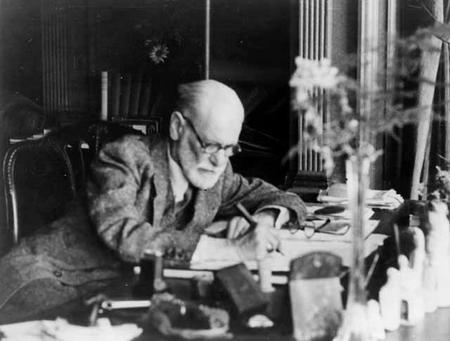
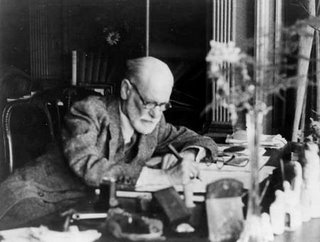
FreudIt was Marx's 188th birthday yesterday, as s0metim3s, carlos rojas, and Steven Shaviro, among others, note. I hope to write up something apropos before long.

But it is Freud's today. And old Sigismund would be 150 were he still alive, which is quite a milestone by anybody's standards.

Moreover, I have returned to thinking about ruins, one of Freud's many obsessions. Freud took a keen interest in archaeology, and his home in Hampstead was filled with a collection of over 2,000 curios that had been excavated from the Ancient World: no wonder the London Freud Museum should comment that, surrounded by his antiquities, Freud "worked in a museum of his own creation". (See also The Vienna Freud Museum.)

As the museum further indicates, these curios were prized for more than their aesthetic value alone. Freud believed they told something of the truth of pyschoanalysis and its theories of the unconscious:
One example of this is Freud's explanation to a patient that conscious material "wears away" while what is unconscious is relatively unchanging: "I illustrated my remarks by pointing to the antique objects about my room. They were, in fact, I said, only objects found in a tomb, and their burial had been their preservation."
Freud often compared the unconscious to buried ruins, and the task of the analyst to that of the archaeologist, uncovering ever deeper strata for the prizes hidden in the depths, clues to the ways of life only dimly discerned from mere surface inspection.

But in a late essay, Freud turns this metaphor on its head. In "A Disturbance of Memory on the Acropolis," ruins stand for what is clearly in view, in front of the analyst's face. And the issue here is why what is so straightforwardly visible, uncompromisingly material, should be strangely denied or disavowed.

Written in 1936, "A Disturbance of Memory" is in fact a kind of birthday present, dedicated to the Nobel Prize-winning writer Romain Rolland "on the occasion of his seventieth birthday." And age, old age, is a constant theme. Freud notes that he himself is "ten years older" than Rolland, and that his "powers of production are at an end" (On Metapsychology 447). There is, therefore, from the outset a melancholy note sounded, a lament for times past and fading strength.

The essay's topic is a recollection from 1904 ("a generation ago" [447]) that has "kept on recurring to [his] mind." It concerns a trip Freud took with his brother, a holiday south to the Mediterranean, first to Trieste, with the intention of continuing on to Corfu. In Trieste, however, the brothers' plans changed. A business acquaintance advises against Corfu and strongly suggests that the two sail for Athens, instead. For some reason, this suggestion provokes in the two travellers "a discontented and irresolute state of mind" (448). Yet, almost unconsciously ("as though it were a matter of course") they book a passage for Athens, and soon enough set out to see the sights.

Freud's reaction to the ancient ruins of which he has heard so much is, he admits, decidedly curious:
When, finally, on the afternoon after our arrival, I stood on the Acropolis and cast my eyes around the landscape, a surprising thought suddenly entered my mind: "So all this really does exist, just as we learnt at school!" To describe the situation more accurately, the person who gave expression to the remark was divided, far more sharply than was usually noticeable, from another person who took cognizance of the remark; and both were astonished, though not by the same thing. The first behaved as though he were obliged, under the impact of an unequivocal observation, to believe in something the reality of which had hitherto seemed doubtful. [. . .] The second person, on the other hand, was justifiably astonished, because he had been unaware that the real existence of Athens, the Acropolis, and the landscape around it had ever been objects of doubt. What he had been expecting was rather some expression of delight or admiration. (449)
The ruins are an instance of what is incontrovertible, plainly in front of Freud's face, but whose reality for some reason some part of him chooses to doubt. What should be a source of affirmation ("delight or admiration") becomes instead the occasion for a deep scission within the self. And Freud goes on to describe this as "a 'feeling of derealization' ['Entfremdungsgefühl']" (453).

This derealization is itself, of course, another mode of denial, of repression. And Freud notes that it is the mirror image of the fantasy, or the "hallucinations," more readily associated with psychic disturbance, and indeed with Freudian theory. Where a fantasy conjures up the unreal, the delusion, its counterpart derealization conjures away what is plainly real. And if fantasies are always images of possession, of incorporation, "in the derealizations we are anxious to keep something out of us" (453); "they aim at keeping something away from the ego, at disavowing it" (454).

Interestingly, Freud takes as a prime example of derealization the famous "moor's last sigh," when the last ruler of Muslim Andalucía, Boabdil, reacted to news of the fall of Alhama:
He feels that this loss means the end of his rule. But he will not "let it be true," he determines to treat the news as non arrivé. The verse runs:

"Cartas le fueron venidas
que Alhama era ganada:
las cartas echó en el fuego,
y al mensajero matara"

["Letters had reached him telling that Alhama was taken. He threw the letter in the fire and killed the messenger."] (454-455)
But Freud observes that what is "truly paradoxical" about his own behaviour on the Acropolis is that, far from denying or repressing a trauma or displeasure, his defence mechanism serves to ward off "something which, on the contrary, promises to bring a high degree of pleasure." At last, a dream attained: why deny it, as though it were "too good to be true" (450)?

And Freud's explanation takes recourse in the concept of the super ego. Rather than warding off an external threat, derealization is symptom of an internal frustration, which "commands [the sufferer] to cling to the external one"; and the internal frustration itself is "a residue of the punitive agency of our childhood" (451).

So back further in time Freud goes: beyond the scene of writing as an eighty year old in 1936; beyond his recollections of a trip undertaken at the age of forty-eight, in 1904; back to his childhood, to his schooldays in the 1860s, and back (but of course) to the familial scene, to the figure he refers to, refracted through an anecdote in which he compares himself to Napoleon, in the strangely distanced, formal and foreign, turn of phrase "Monsieur nôtre Père" (456).

It is not, then--and this at last is the "disturbance of memory" signalled in the essay's title--that at school the young Freud had doubted the Acropolis's existence. Rather:
It seemed to me beyond the realms of possibility that I should travel so far--that I should "go such a long way." This was linked up with the limitations and poverty of our conditions of life in my youth.

[. . .]

But here we come upon the solution of the little problem of why it was that already at Trieste we interfered with our enjoyment of the voyage to Athens. It must be that a sense of guilt was attached to the satisfaction in having gone such a long way; there was something about it that was wrong, that from earliest times had been forbidden. It was something to do with a child's criticism of his father, with the undervaluation which took the place of the overvaluation of earlier childhood. It seems as though the essence of success was to have got further than one's father, and as though to excel one's father was still something forbidden. (455, 456)
No surprises here, then. In a caricature of pop cult images of pyschoanalysis, the whole incident with the ruins comes to revolve around an Oedipal anxiety: the desire to supersede the father, and the attendant feelings of guilt. The short-cut to interpretation, as always, being to intone in heavily accented English: "Tell me about your father."

Fortunately, and this is the great delight with Freud, he leaves himself open to another interpretation altogether: one that is right in front of his face, if only he'd see it.

For again, the essay ends as it had started, with a lament as to the analyst's own declining powers, a nostalgic sigh from one old man to another, on the occasion of the somewhat younger man's birthday:
And now you will no longer wonder that the recollection of this incident on the Acropolis should have troubled me so often since I myself have grown old and stand in need of forbearance and can travel no longer. (456)
Freud admits that he himself is now needy and dependent. He lacks the mobility of his youth. He can easily be overtaken. Is not the issue then less his own father, than his position as father, literal and metaphorical, of the movement that he started but can no longer keep up with?
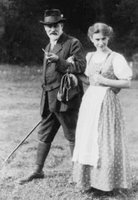
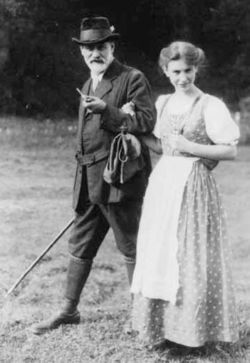
Sigmund and Anna FreudLiteral in that ("Tell me about your daughter"?) Freud has already referred to his daughter, Anna, precisely at the moment that he introduced the theme of ego defences:
An investigation is at this moment being carried on close at hand which is devoted to the study of these methods of defence: my daughter, the child analyst, is writing a book upon them. (454)
Surely there are some revealing turns of phrase here, though one would have also to examine the original German text.

The "child analyst," in English at least, might suggest both that she analyzes children, and that she is herself still (to Freud) but a child, if only in terms of analysis. But is there not some anxiety in the assurance that Anna remains "close at hand": close because he now needs her close by, to continue his legacy; too close to comfort because it is she who is the future author, catching up on Freud while his own "powers of production are at an end"; perhaps too likely to stray, close now but soon distant, superseding or betraying her father?

And metaphorical in that... Well, can we not read this whole tale, and the birthday essay that has accreted around it, as a metaphor for the fate of psychoanalysis itself? Is not the split subject that gazes at the old, split rocks of the Parthenon the split subject of pyschoanalysis?

Though Freud starts to discuss "the extraordinary condition of 'double conscience'" as a means to understand this condition (453), all too soon he disavows this very concept: "But all of this is so obscure and has been so little mastered scientifically that I must refrain from talking about it any more to you" (454). Freud the little Napoleon chooses silence, repression, because of an anxiety patently about the possibility of losing mastery, about the limits of a method he would like to convince us is in some way scientific.

And yet it is precisely this double consciousness that is most startling, most plainly in view in the entire anecdote! Indeed, the entire story would be impossible were it not for the "second person," whose astonishment at the "first person"'s derealization functions to insist that his denial is indeed in some way pathological. This second person is on the side of reality, of affirmation, of a literal reading of what stares the analyst straight in the face.

And is not this second person, found within the analyst, and enabling his melancholy remembrance, his sad intepretations, the hint of a psychoanalysis that would not be bound to the super ego, to the childhood traumas imposed by a fading father figure? Doesn't this second person, the other side of Freud's double consciousness, hold the keys to a schizoanalysis? A schizoanalysis that begins with the "split personality" (453-454) that so shakes Freud and his illusion of scientific mastery that he has to guard his silence and return (oh, once again) to the old mournful tale of fathers and sons, itself only a cover for a still more pathetic anxiety over fathers and daughters?
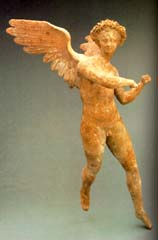
ErosIt is double consciousness, which includes the wild, unscientific analysis so feared by Freud, that makes the entire procedure productive, that gives the lie to Freud's own self-pitying complaint that production is "at an end." If only it were at an end, thinks Freud; if only he could put a stop to it. It's so evidently in his face. And yet it is this other side to pyschoanalysis that he is most anxious to disavow.

Despite himself, Freud let a genii out of the bottle that still, 150 years after his birth, returns to enliven but also (affirmatively, joyfully, impiously, youthfully playing among the ruins) traduce and betray, supersede and go beyond, the psychoanalytic enterprise that our birthday boy set in motion. Why deny it?

Cross-posted to Long Sunday.

For more, check out the naked gaze's "Obscene Images (1)".

And for other birthday tributes, see Harold Bloom's "Why Freud Matters", Paul Broks's "The Ego Trip", Will Hutton's "A time to celebrate, not denigrate, Freud", or Christina Patterson's "A Freud for all seasons". MotherPie offers some feminist commentary and a whole series of links. And here's Freud's last living patient.

Plus a site dedicated to the anniversary.

Thursday, April 27, 2006

eclecticism

Somewhat late in the day, there's been a minor dust-up in the Spivak event over the concept of a "higher eclecticism." See Scott Kaufman's post at the Valve, "Arguments about Higher Eclecticism, as Illustrated by Two Paintings with One Name".

Sketch for Sgt Pepper album cover(Oh, and let me say that I have never liked Mark Tansey's work. I remember seeing him speak once, and asking a question suggesting he was just a highbrow Peter Blake.)

I felt myself rather misrepresented in that post (as I try to clarify in the subsequent comments). But the fact that my name was invoked arises in part from my suggestions at various times that it'd be worth formulating some kind of defence of eclecticism, if not necessarily a "higher eclecticism."

As a place-holder for such a defence, let me rescue and elaborate slightly upon a comment I made elsewhere, in the discussion that originally led up to the Spivak symposium...

I have no real idea what John Holbo means by "higher eclecticism," but in many ways I'd happily admit that my own work is concerned with, and operates though, a form of (perhaps lowdown and dirty) eclecticism.

Put it this way: I enjoy and find productive the activity of bringing together apparently divergent traditions of thought and cultural enquiry, and seeing what emerges from the ensuing collision.

I do that both with theorists (Deleuze and Bourdieu, for instance, who are certainly unlikely bedmates), but also more generally with Area Studies and Theory, and/or with Latin American reflections on culture and Anglo-American approaches to culture.

I wouldn't want to argue that there's some natural affinity between these traditions, nor that their contradictions or differences can be resolved. It's not an attempt to totalize or homogenize. Far from it, in fact; I'd rather preserve their heterogeneity. But I do think that the sparks that fly off in the encounters or clashes between divergent series is indeed illuminating. I'm thinking here in part of Deleuze's reflections on the series, and the "strange attractor" that communicates between them like a lightning flash.

Anyhow, I'm not necessarily advocating this as some kind of transferable master plan. (There might after all be some self-contradiction were I to do so...) But it works well enough for me.

And if that's "higher eclecticism," then so be it.

Though if I were to be suitably self-regarding and self-conscious, I'd probably turn to concepts within the traditions I work with--such as "mestizaje" or "transculturation" or "hybridity," say--as my own personal descriptors. After all, these terms (hybridity and so on) are crucial to the way in which we've understood Latin American (and more generally, postcolonial) culture. Why not work with them? Even if we have to differentiate between different modes of eclecticism (higher vs. lower, dirty vs. clean, I don't know), just as Alberto Moreiras distinguishes a "savage" hybridity.

But if the alternative to eclecticism is disciplinarity, purity, respect for lineage... then I'll choose eclecticism every time.

Monday, April 24, 2006

anecdotage

This post is part of Long Sunday's "Carnival of Gayatri Chakravorty Spivak".

Before I attempt to bring some threads together, a bit of anecdotage, that may also prove illuminating about value and global communications.

Blair, The Third WayA few years ago, at a time that I was working in Manchester, England, I happened to be in North Carolina for a conference. There I received an email from my friend Jean Franco, who taught for many years at Columbia (she is now emerita) and is one of Gayatri Spivak's closest friends. She'd just got back to the States from London and said she had "an immense favour to ask." Gayatri had phoned her from Hong Kong, "in a state of agitation," because she needed to get hold of a book by Tony Blair, The Third Way, in advance of her keynote at the British Sociological Association conference in Manchester at the weekend. It was now Wednesday. Jean passed along Gayatri's temporary email address in Hong Kong so we could make further arrangements.

I forwarded all this back to my partner, Susan, back in Manchester, to see if she might be able to pick up the book and drop it off at the relevant hotel. And I wrote to Gayatri to assure her that measures were being taken to ensure the text's arrival. She wrote back:
My Ma always tells me, in her heavily (Bengali)accented Sanskrit: swadeshe pujyate raja vidyan sarvatra pujyate (a king is worshipped in his own kingdom, a learned man everywhere). I laugh at her, usually. But Giddens's books are all over the place, but neither Blair's nor Clinton's offerings are to be found in any library or bookstore in Hong Kong or New York! O tempora, o mores.
Susan then chipped in with the information that
I've managed to track down a copy of The Third Way for you--though even in his own land, this king's publications are hard to find!
For it had turned out that a copy of the book was not to be had in Manchester for love or money, either, but that a phone call to the Fabian Society meant that the book would be sent North post haste. And indeed, Susan picked it up and left it at the hotel for Gayatri to collect.

A little while later, a note arrived in the post, written on the back of a scrap of stationery from Air India's Maharajah Lounge in Hong Kong. Enclosed was the money that the book had cost, thanks to Susan for her trouble, apologies for a "peculiar smudge" (circled and arrowed) and the explanation that "this is the only piece of paper I have, would you believe. My paper was awful. Best, Gayatri."

I like this story for a number of reasons. First because it shows something of the worries, the charm, the humour, and also the self-deprecation of someone so often described as "difficult" (with all the overtones that such a description carries).

Second, because it's an instance of a fairly extraordinary ad hoc network coming together to get something done: a phone call from Hong Kong to New York; an email from there to North Carolina, and then on to Manchester and back to Hong Kong; a phone call to London, and a series of deliveries to and within Manchester; and finally the note, its textuality and materiality physically marked and commented upon, and money repaid. It's a dizzying circulation of information, people, commodities, and money. All kinds of debts and favours and friendships or affects are called in and granted or extended, in a circuit that overlaps with and enables the purchase, distribution, and consumption of a particular commodity, but that is in no way simply reducible to the economic.

And so third, there's a moral about value--intellectual, academic, cultural, and political as well as financial--as it is translated across borders and across generations, even across languages. "Swadeshe pujyate raja vidyan sarvatra pujyate": a fable about the relativity of prestige, at first "heavily [. . .] accented" in a language I at least do not understand, gently laughed at by she who does, perhaps because it seems an "inadequate" or naive view of the world; but it's a saying that becomes more than adequate, something like a durable snippet of wisdom from "Ma" about the limitations of temporal power, even in an age of Empire and globalization.

Cross-posted to Long Sunday.

Tuesday, April 18, 2006

discontinuity

This post is part of Long Sunday's "Carnival of Gayatri Chakravorty Spivak".

I'm going to jump in here with a brief note on continuity and discontinuity in Spivak's text, "Scattered Speculations on the Question of Value."

The nub of Spivak's argument is this: she presents a critique, first, of what she terms "the continuist version of Marx's scheme of value" (In Other Worlds 155), but second and more importantly, also of "all ideologies of adequation and legitimacy" (171).

The notion of value as continuity (of unruffled exchange, or even a series of more or less orderly exchanges and transformations) is at best mistaken, at worst ideological, and so complicit.

Hence Spivak's recourse to "the concept-metaphor of the text" (171) and textuality, to indicate the overdeterminations, the loose ends, the "situation of open-endedness" that characterizes the process by which value is produced as "an insertion into textuality" (161).

But the point is that there are discontinuities and then there are discontinuities.

For if capitalism puts forward ideologies of continuity, the latest of which is the dream of unregulated world-wide instantaneity effected in globalization, in fact it functions always by means of a series of ruptures, of breaks in that flow. Globalization can only be a tendency, another version of the same basic ideology of continuity. In practice, "even as circulation time attains the apparent instantaneity of thought (and more), the continuity of production ensured by that attainment of apparent coincidence must be broken up by capital" (166). Here, maintaining a distinction between productive center and comprador peripery, between the First World and "the dark presence of the Third" (167), is crucial. But also even immediately in the production process: value arises from the discrepancy between use and exchange, from the super-adequation of labour power. It is discontinuity, not continuity, that constitutes the ruse of capital.

Yet Spivak will have no truck with any notions of flow and immanence counterposed to capitalist segmentarity. From the outset she brackets off "the anti-Oedipal argument" of Deleuze and Guattari as "but a last-ditch metaphysical longing" (154). Moreover, and for all her agreement with the notion of capital's liberating aspects, its "'freeing' of labor-power" (161), she is harsh in her critique of any utopian faith in what we might call the deterritorializing powers of Empire. "Telecommunication" (for which we could substitute now the powers of cognitive or communicational labour) only "seems to bring nothing but the promise of infinite liberty for the subject" (167; my emphasis). And this is because "economic coercion as exploitation is hidden from sight in 'the rest of the world'" (167).

No. Against discontinuity: more discontinuity, or perhaps better, other modes of discontinuity. Against the capitalist ruse of extracting surplus in the discrepancy between labour power and exchange value, Spivak defends what she describes as the "radical proto-deconstructive cultural practice" of "bricolage, to 'reconstellate' cultural items by wrenching them out of their assigned function" (170). This is, no doubt, a defence of eclecticism. And here, incidentally, Deleuze and Guattari somewhat surprisingly reappear, now applauded for their concept of desiring-machines as "originarily unworkable" (170).

But here's the question, and in some ways it's a question for Deleuze and Guattari too: can in fact these two modes of discontinuity, the one governed by capitalist expansiveness, the other by a principle of avant-garde defamiliarization, really be distinguished so easily? Can we still say so unreservedly that "the computer, even as it pushes the frontiers of rationalization, proves unable to achieve bricolage" (170)?

Or to put it another way: Spivak recognizes a certain ambivalence in the word-processor, and so in the machinic and the collaborative communicational labour it enables; but does she explore that ambivalence far enough?

1980s word processor
Cross-posted to Long Sunday.